Southeast Asia
Austronesian, Tai–Kadai, Austroasiatic — the tropical crossroads of Asia.
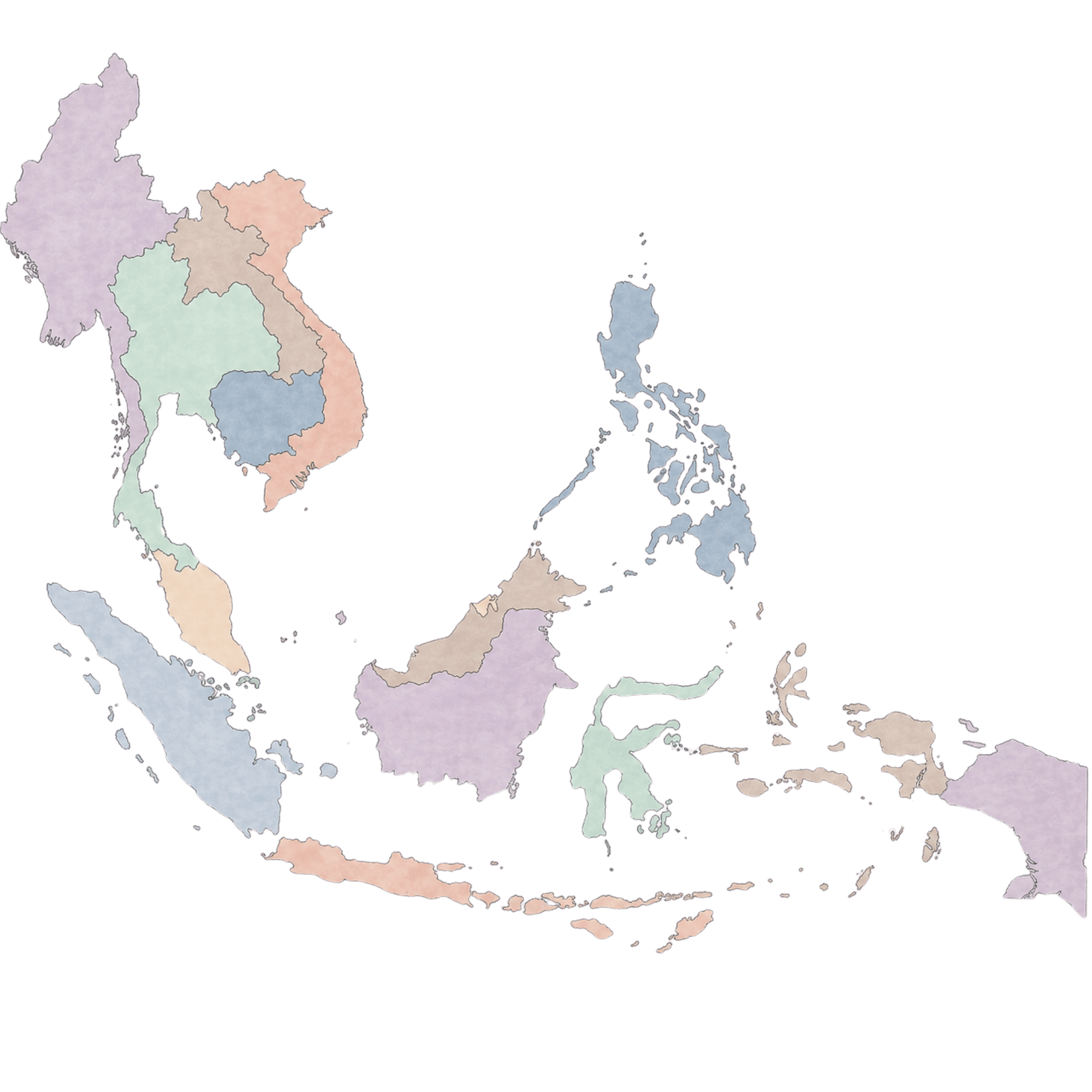
Countries
All countries →Dialects in this region
All dialects →Australian English
also: General Australian
The mainstream variety of Australian English, used by the majority of speakers nationally. The General Australian sociolect, sitting between Broad and Cultivated extremes.
Broad Australian
also: Strine
The most strongly-marked sociolect of Australian English, traditionally rural and outback in association. Famously caricatured as "Strine"; recognisable by its diphthongal vowels and broad nasalisation.
Cultivated Australian
The historically prestigious Australian English variety, modelled on British Received Pronunciation. Once dominant in broadcasting and law; now rare in everyday speech.
Aboriginal Australian English
also: AAE
A distinct Australian English variety used widely across Aboriginal communities. Shows substrate influence from many Aboriginal languages and forms a continuum with Kriol in northern Australia.
Singlish
also: Singapore Colloquial English
The colloquial English of Singapore, mixing English with grammatical features and lexicon drawn from Hokkien, Malay, Cantonese, and Tamil.
Hanoi Vietnamese
also: Northern Vietnamese, Standard Vietnamese
The Northern Vietnamese variety of Hanoi. The basis of the national standard and of most Vietnamese taught abroad.
Huế Vietnamese
also: Central Vietnamese
The Central Vietnamese variety of Huế. Preserves a distinctive five-tone system and lexicon rooted in the former Nguyễn-dynasty imperial capital.
Saigon Vietnamese
also: Southern Vietnamese, Hồ Chí Minh City
The Southern Vietnamese variety of Ho Chi Minh City. The most widely heard variety abroad, carried by the post-1975 Vietnamese diaspora.
Bahasa Indonesia
also: Standard Indonesian
The national lingua franca and official language of Indonesia, derived from Malay and shaped by extensive contact with Javanese, Sundanese, Dutch, and English.
Bahasa Malaysia
also: Malaysian Malay, Bahasa Melayu
The Malay standard of Malaysia. Shares core grammar with Indonesian but differs in vocabulary, with stronger English borrowings and distinct spelling conventions.
Brunei Malay
also: Bahasa Melayu Brunei
The Malay variety of Brunei. A vernacular distinct from both Bahasa Malaysia and Indonesian, used as the everyday spoken standard alongside formal Bahasa Melayu.
Central Thai
also: Standard Thai, Bangkok Thai
The Bangkok-area variety that forms the basis of the modern Thai standard. The reference variety in education, broadcasting, and most Thai instruction abroad.
Isan
also: Northeastern Thai, Lao-Isan
The Tai language of Thailand's Northeast region. Closer to Lao than to Central Thai; spoken by the largest non-Central-Thai population in the country.
Lanna
also: Northern Thai, Kham Mueang
The Tai language of Thailand's Northern region around Chiang Mai. Carries its own historical script and a literary tradition tied to the former Lanna kingdom.
Manila Tagalog
also: Filipino, Standard Tagalog
The Manila-area variety that forms the basis of Filipino, the national language of the Philippines. Heavily mixed with English in everyday speech (Taglish).
Batangas Tagalog
also: Batangueño
The Tagalog of Batangas province, often cited as more conservative than Manila Tagalog. Preserves several older verb forms and a distinctive intonation.
Bulacan Tagalog
The Tagalog of Bulacan province, just north of Manila. Historically influential as a literary variety in the development of modern Filipino.
Standard Burmese
also: Yangon Burmese
The Yangon-area variety that forms the basis of standard Burmese. The national lingua franca and the medium of education and broadcasting in Myanmar.
Mandalay Burmese
also: Upper Burmese
The Burmese of Mandalay and Upper Myanmar. Often described as the more conservative variety, especially in pronunciation of historical consonant clusters.
Te Reo Māori
also: Standard Māori
The Māori language of Aotearoa New Zealand. An Eastern Polynesian language and one of New Zealand's official languages, central to ongoing language-revitalisation efforts.
Eastern Māori
The Māori varieties of the East Coast of the North Island. Distinguished by tribal lexicon and tonal patterns associated with iwi of the region.
Gagana Sāmoa
also: Samoan
The Polynesian language of the Samoan Islands. The official language of Samoa and one of the official languages of American Samoa, with sizeable diaspora communities in New Zealand and the United States.
Chavacano
also: Chabacano, Zamboangueño, Philippine Creole Spanish
A Spanish-based creole language of the Philippines, with its strongest living community in Zamboanga City and related varieties historically spoken in Cavite, Ternate, and Cotabato. It preserves much Spanish vocabulary while using a Philippine grammatical frame shaped by local languages.
Pitjantjatjara
also: Western Desert language, Anangu
A Western Desert language of central Australia, spoken by the Anangu communities around Uluṟu and the APY Lands. One of the most-spoken Aboriginal Australian languages, with active bilingual education.
Warlpiri
A Pama-Nyungan language of the Tanami Desert in the Northern Territory. Spoken across communities including Yuendumu and Lajamanu; the subject of substantial linguistic documentation.
Yolŋu Matha
also: Dhuwal-Dhuwala, Yolngu languages
A cluster of closely-related Pama-Nyungan languages spoken across Yolŋu communities of north-east Arnhem Land. Centred on Yirrkala and Galiwinʼku.
Kriol
also: Australian Kriol
An English-based creole spoken across northern Australia by Aboriginal communities, especially in the Northern Territory and the Kimberley. Native to many speakers and used in bilingual schools and broadcasting.
Torres Strait Creole
also: Yumplatok, Broken
An English-based creole spoken across the Torres Strait Islands and adjacent communities of far northern Queensland. Closely related to Tok Pisin and Bislama within the Melanesian Pidgin family.
Javanese
also: Basa Jawa
The largest Austronesian language by speakers, used across central and eastern Java and as a regional lingua franca. Distinguished by an intricate honorific system (krama / madya / ngoko).
Sundanese
also: Basa Sunda
A Malayo-Polynesian language of western Java, the second-largest regional language of Indonesia after Javanese. Around 40 million speakers, with its own honorific register system.
Cebuano
also: Bisaya, Binisayâ
A Visayan Austronesian language of the central and southern Philippines. The most widely-spoken language of the Visayas and Mindanao, often counted as the largest Philippine language by L1 speakers.
Ilocano
also: Iloko, Ilokano
An Austronesian language of north-western Luzon, the third most-spoken language of the Philippines. Used widely as a regional lingua franca across northern Luzon.
Tongan
also: Lea Faka-Tonga
A Polynesian language and the official language of Tonga. Distinct among Polynesian languages for retaining a definite/indefinite article system inherited from Proto-Polynesian.
Fijian
also: Vosa Vakaviti
An Austronesian language and an official language of Fiji. Often used alongside Fiji English and Fiji Hindi, the country's three official languages.
Tahitian
also: Reo Tahiti
A Polynesian language and one of the official languages of French Polynesia. The largest of the Tahitic languages, with around 70,000 speakers across French Polynesia and the diaspora.
Khmer
also: Cambodian
An Austroasiatic language and the official language of Cambodia. The largest non-Tai-Kadai language of mainland Southeast Asia, with a literary tradition dating back to the 7th century.
Mon
An Austroasiatic language of Lower Burma and adjacent Thailand. Once the dominant cultural language of mainland Southeast Asia, displaced over centuries by Burmese and Thai expansion.
Mlabri
also: Mrabri, Yumbri
A Khmuic (Austroasiatic) language of formerly nomadic hunter-gatherers in the highlands of Nan and Phrae provinces, northern Thailand, and adjacent Laos. Roughly 100–300 speakers; its numeral system allows only one and two to modify nouns, and it lacks the register contrasts typical of related languages.
Lao
A Tai-Kadai language and the official language of Laos. Closely related to Thai Isan; written in a script derived from the same source as Thai but distinct in several letters and vowel signs.
Enga
A Trans-New Guinea language and the largest Papuan language by speakers, used across Enga Province in the western highlands of Papua New Guinea. Around 250,000 speakers.
Kuman
also: Simbu
A Trans-New Guinea language of the Chimbu / Simbu Province in the central highlands of Papua New Guinea. Around 80,000 speakers.
Tiwi
A non-Pama-Nyungan language of the Tiwi Islands north of Darwin, the only living member of its family. One of the most morphologically complex languages on record, with a famously elaborate noun-classification system.