East Asia
Sinitic, Japonic, Koreanic — the language families of East Asia.
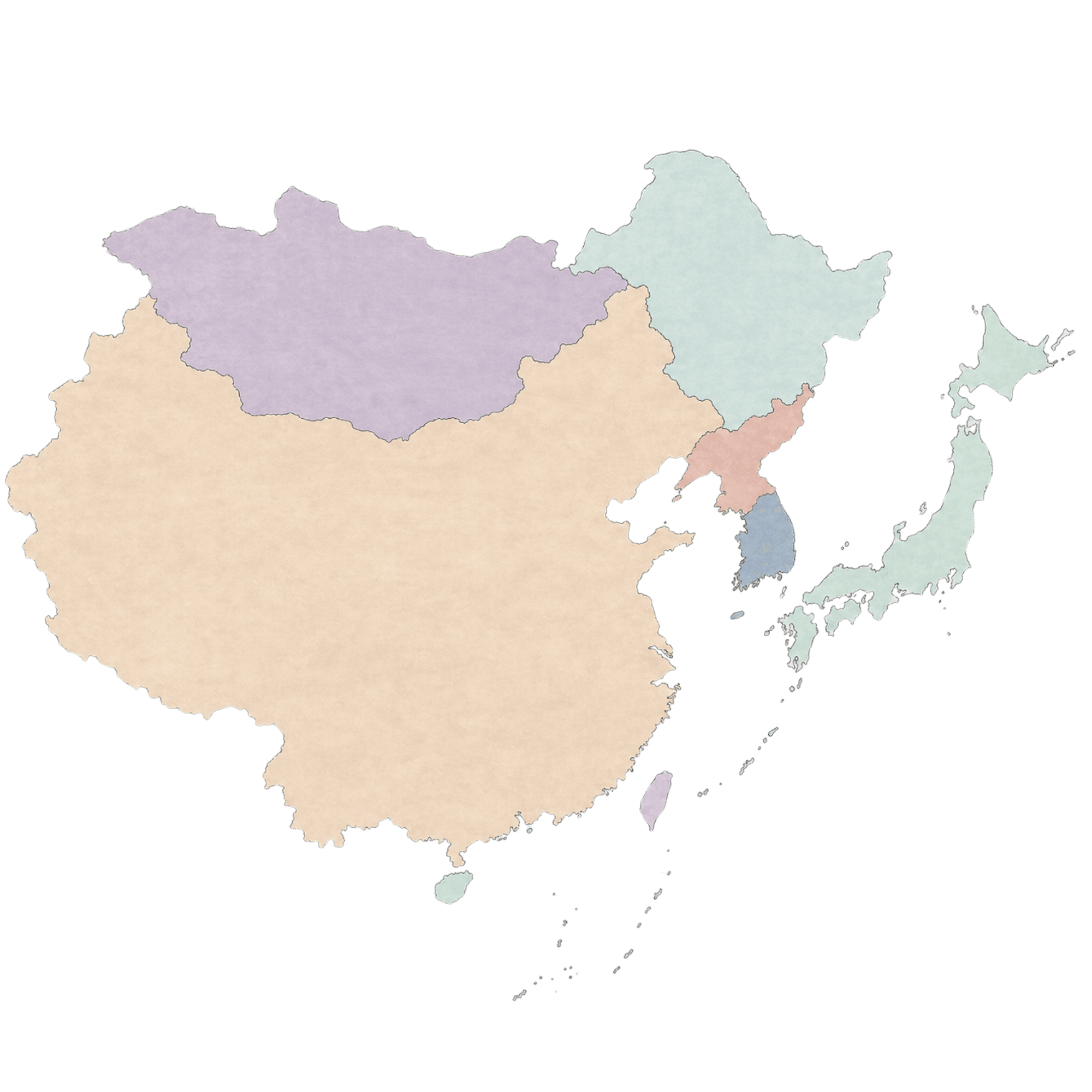
Dialects in this region
All dialects →Tokyo Japanese
also: Hyōjungo, Standard Japanese
The Tokyo-area variety that forms the basis of Standard Japanese (Hyōjungo). Carried nationwide by broadcasting, education, and government use.
Kansai-ben
also: Kansai dialect, Kinki dialect, Osaka-ben
The major dialect group of the Kansai region, with Osaka as its modern centre. Strongly distinct from Tokyo Japanese in pitch accent, copula forms, and idiom. Kyoto-ben is treated separately here.
Kyoto-ben
also: Kyō-kotoba, Kyoto dialect
The Kyoto variety of Kansai Japanese. Historically the prestige speech of the imperial court, marked by softer cadence, distinct honorific forms, and a long literary heritage.
Hakata-ben
also: Fukuoka dialect
The dialect of Fukuoka and the Hakata district on northern Kyushu. Recognisable for sentence-final particles like "to" and "tai".
Tōhoku-ben
also: Tōhoku dialect, Zūzū-ben
The dialects of north-eastern Honshu around Sendai. Distinguished by reduced vowel contrasts and merged sibilants — historically caricatured as "zūzū-ben".
Hokkaido-ben
The variety spoken across Hokkaido. A relatively young dialect shaped by 19th-century settlement, mostly close to Standard Japanese but with Tōhoku and coastal influences.
Hiroshima-ben
also: Geibi dialect
The Chūgoku-region dialect of Hiroshima and surrounding Geibi area. Known to many Japanese viewers through Hiroshima-set film and television.
Nagoya-ben
also: Owari dialect
The dialect of Nagoya and the Owari plain. Sits between the Tokyo and Kansai regions and shares features with both, while keeping a distinct vowel inventory.
Miyakoan
also: Miyako, Miyako Ryukyuan, Miyako language
A Southern Ryukyuan Japonic language of the Miyako Islands in Okinawa Prefecture. Not mutually intelligible with Standard Japanese; preserves distinctive Ryukyuan phonology and is severely threatened by shift to Japanese.
Beijing Mandarin
also: Pekingese, Standard Mandarin (basis)
The Beijing-area variety of Mandarin and the phonological basis of Standard Chinese (Pǔtōnghuà). Distinguished by heavy erhua and clipped syllable-final endings.
Northeastern Mandarin
also: Dōngběi Huà
The Mandarin of China's three Northeastern provinces around Shenyang and Harbin. Close to standard Mandarin but with a distinctive intonation and rich slang.
Sichuanese Mandarin
also: Sìchuānhuà
A Southwestern Mandarin variety spoken across Sichuan and Chongqing. Notably divergent in tones and vocabulary, often partially unintelligible to standard speakers.
Yunnan Mandarin
also: Yúnnánhuà
The Southwestern Mandarin of Yunnan province. Carries strong contact influence from neighbouring Tibeto-Burman and Tai-Kadai languages.
Taiwanese Mandarin
also: Guóyǔ, ROC Standard Mandarin
The Mandarin standard of Taiwan. Diverges from Mainland Pǔtōnghuà in pronunciation, lexicon, and tone, with substantial influence from Taiwanese Hokkien.
Hong Kong Cantonese
also: Yuè, HK Cantonese
The Yue Chinese variety of Hong Kong, the most internationally recognised Cantonese. Prestige variety of Cantonese-language film, music, and broadcasting.
Guangzhou Cantonese
also: Canton Cantonese, Guǎngzhōuhuà
The Cantonese of Guangzhou and the broader Pearl River Delta. The historical prestige Cantonese; closely related to Hong Kong Cantonese but with distinct vocabulary.
Taishanese
also: Toisanese, Hoisan-wa
A divergent Yue Chinese variety from the Sze Yup region of Guangdong. Once the dominant variety in early Chinese-American communities, especially in San Francisco and New York.
Seoul Korean
also: Standard Korean, Pyojuneo
The Seoul-based standard of South Korean. Carried nationwide by broadcasting and public education, and the basis of most Korean instruction abroad.
Gyeongsang
also: Southeastern Korean, Busan dialect
The Korean of Busan and the south-eastern Gyeongsang region. The most widely recognised non-standard Korean dialect, marked by its pitch-accent system.
Jeolla
also: Southwestern Korean
The Korean of the south-western Jeolla region around Gwangju. Distinct vowel realisations, sentence-final endings, and a strong rural culinary lexicon.
Jeju
also: Jejueo
The variety of Jeju Island, often classified as a separate Koreanic language. Carries archaic features lost on the mainland and is critically endangered.
Far Eastern Russian
also: Dalnevostochny govor
The Russian of the Russian Far East around Vladivostok and Khabarovsk. The youngest major regional variety, formed through 19th- and 20th-century settlement; close to standard Russian with regional vocabulary tied to Pacific life.
Khalkha Mongolian
also: Standard Mongolian, Khalkh
The Khalkha-based standard of Mongolia. The official language of the country and the largest Mongolic variety; written in Cyrillic since the mid-20th century, with a planned return to traditional Mongolian script.
Inner Mongolian
also: Chakhar Mongolian, Southern Mongolian
The Mongolian of China's Inner Mongolia Autonomous Region, centred on Hohhot. Closely related to Khalkha but written in the traditional vertical Mongolian script and with strong Mandarin contact features.
Buryat
also: Buryat-Mongolian, Buryad
A northern Mongolic language spoken across the Buryat Republic in Russia, northern Mongolia, and parts of north-eastern China. Traditional Buddhist literary language of the Trans-Baikal region.
Oirat
also: Western Mongolian, Dörbed
A western Mongolic language spoken across western Mongolia (Khovd, Bayan-Ölgii) and parts of Xinjiang in China. Sister to Kalmyk, with a separate writing tradition based on the Clear Script (Todo Bichig).
Daur
also: Dagur
A divergent Mongolic language spoken in Heilongjiang and Inner Mongolia in north-eastern China. Geographically isolated from the rest of the family and shaped by long contact with Manchu and Mandarin.
Sakha
also: Yakut, Sakha tyla
The Siberian Turkic language of the Sakha Republic in north-eastern Russia. The northernmost Turkic language and one of the most linguistically divergent, with extensive Mongolic and Tungusic influence.
Sirenik
also: Sireniki Yupik, Old Sirenik
A highly divergent Eskaleut language of the village of Sireniki on the southern Chukchi peninsula, mutually unintelligible with its nearest Yupik relatives and sometimes treated as a third Eskimo branch. Died with its last speaker in 1997; the community now speaks Central Siberian Yupik and Russian.
Manchu
A Tungusic language and the historical court language of the Qing dynasty (1644-1912). Now critically endangered, with only a handful of native speakers in Heilongjiang.
Evenki
A Tungusic language of indigenous reindeer-herding communities across central and eastern Siberia and northern China. The most geographically dispersed Tungusic language.
Nanai
also: Goldi
A Tungusic language of the lower Amur basin, spoken in Russia's Khabarovsk Krai and adjacent China. Around a thousand speakers, all elderly.
Hmong
also: Miao
A cluster of Hmong-Mien languages spoken across the highlands of southern China, northern Vietnam, Laos, and Thailand. Carried abroad through the post-Vietnam-War Hmong diaspora to the United States, France, and Australia.
Mien
also: Yao
A cluster of Hmong-Mien languages spoken by the Yao peoples across southern China and adjacent Southeast Asia. Sister branch to Hmong, with around 800,000 speakers across the diaspora.
Wu (Shanghainese)
also: Shanghai Wu, Shanghainese
The largest Wu Chinese variety, spoken across Shanghai and the lower Yangtze. The second-largest Sinitic language by speakers after Mandarin, distinct enough that it is mutually unintelligible with Mandarin.
Min Nan (Hokkien)
also: Hokkien, Taiwanese
The largest Min Chinese variety, spoken in Fujian and Taiwan and across the Hokkien-speaking diaspora of Southeast Asia. The basis of Taiwanese Hokkien and a major contributor to Singaporean Hokkien.
Hakka
also: Kèjiā huà
A Sinitic language spoken across pockets of southern China and Taiwan by the Hakka diaspora communities. Around 35 million speakers, with major communities in Guangdong, Fujian, and Taiwan.
Chukchi
also: Lygʼoravetlʼan
A Chukotko-Kamchatkan language of the Chukotka Peninsula in north-eastern Siberia. Around 5,000 speakers; one of the few languages with male and female speech-form distinctions.
Koryak
also: Nymylan
A Chukotko-Kamchatkan language of the Kamchatka peninsula. Spoken by Koryak reindeer herders and coastal communities; sister language to Chukchi within the Chukotian sub-branch.
Itelmen
also: Western Kamchadal
The sole surviving language of the Kamchatkan branch of Chukotko-Kamchatkan, spoken in villages along the western coast of Kamchatka such as Kovran. Only a few elderly fluent speakers remain; known for extremely complex consonant clusters, and structurally so divergent from Chukchi-Koryak that its place in the family is debated.
Ainu
A language isolate of the indigenous Ainu people of Hokkaido and historically Sakhalin and the Kuril Islands. Critically endangered with only a handful of native speakers; subject of an active revitalisation effort.
Ket
The last living Yeniseian language, spoken along the middle Yenisei in central Siberia. Around 200 elderly speakers; recently linked to the Na-Dené family of North America in the controversial Dene-Yeniseian hypothesis.
Nivkh
also: Gilyak
A language isolate of Sakhalin and the lower Amur basin in Russia. Critically endangered; one of the few Paleo-Siberian languages with no demonstrated relatives.