Latin America & the Caribbean
Spanish, Portuguese, French-based Creoles, and the indigenous languages of Central and South America and the Caribbean islands.
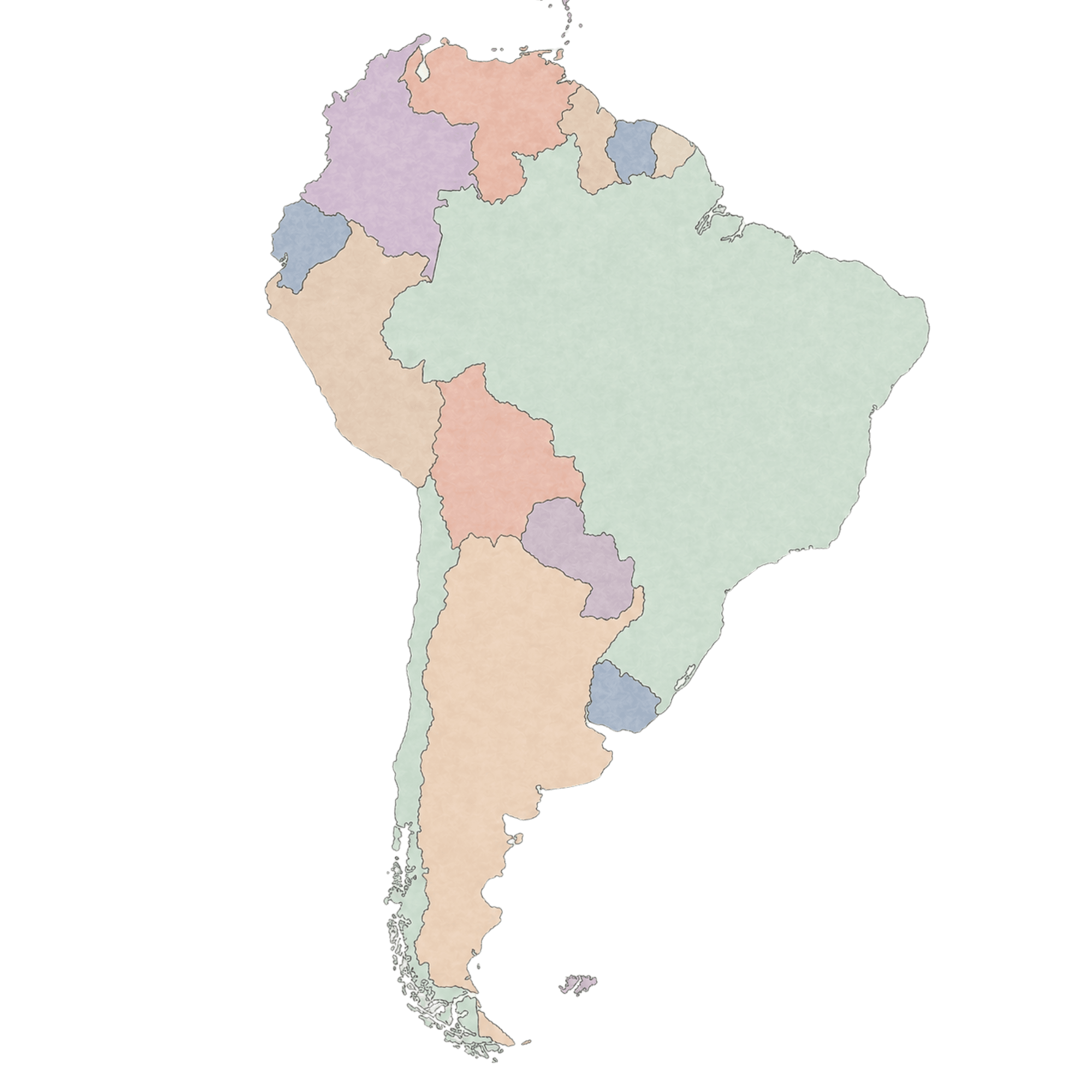
Countries
All countries →Dialects in this region
All dialects →Hunsrik
also: Brazilian German, Riograndenser Hunsrückisch, Hunsrückisch
A German-derived minority variety spoken by descendants of nineteenth-century settlers in southern Brazil, especially Rio Grande do Sul, Santa Catarina, and Paraná. It descends mainly from Hunsrück Franconian and has developed under long contact with Brazilian Portuguese.
Caribbean Spanish
The Spanish of Cuba, the Dominican Republic, and Puerto Rico. Shares with Andalusian the aspiration of /s/ and the loss of final consonants, and carries a distinctive lexicon shaped by Taino and African languages.
Colombian Spanish
also: Bogotano
The Spanish of Colombia, internally varied by region. The Andean Bogotá variety is widely cited for its conservative phonology and is often described as one of the clearest spoken varieties in the Americas.
Andean Spanish
The Spanish of the Andean highlands across Peru, Bolivia, and Ecuador. Heavily influenced in pronunciation, grammar, and lexicon by Quechua and Aymara.
Rioplatense Spanish
also: Río de la Plata Spanish
The Spanish of Argentina and Uruguay. Distinctive for its voseo verb forms, the sheísmo / zheísmo realisation of <ll>/<y>, and a strong Italian-influenced intonation.
Chilean Spanish
The Spanish of Chile. Known for rapid speech, heavy aspiration of /s/, distinct second-person verb forms, and a rich slang lexicon.
Venezuelan Spanish
The Spanish of Venezuela, centred on Caracas. A Caribbean Spanish variety closely related to Cuban and Dominican Spanish, with strong /s/-aspiration and a distinctive lexicon.
Ecuadorian Spanish
also: Costeño Ecuadoriano
The Spanish of coastal Ecuador, centred on Guayaquil. Distinct from the Andean Quito variety, with stronger Caribbean Spanish features including /s/-aspiration.
Bolivian Spanish
also: Cochabambino, Camba (Lowland Bolivian)
The Spanish of Bolivia, internally split between Andean (La Paz, Cochabamba) and Lowland Camba (Santa Cruz) varieties. Heavy contact features from Quechua and Aymara in the highlands.
Mineiro
also: Belo Horizonte Portuguese
The Brazilian Portuguese of Minas Gerais and the surrounding interior. Distinguished by characteristic vowel reductions, monophthongisation of diphthongs, and a distinctive lexicon.
Gaúcho
also: Sulista, Southern Brazilian Portuguese
The Brazilian Portuguese of Rio Grande do Sul and southern Brazil. Distinct from northern Brazilian varieties, with strong Spanish (Rioplatense) and Italian/German immigrant contact features.
Paulistano
also: São Paulo Portuguese
The Portuguese of São Paulo and the surrounding state. The most populous Brazilian variety and a common reference for the broader Brazilian standard.
Carioca
also: Rio de Janeiro Portuguese, Fluminense
The Portuguese of Rio de Janeiro. Recognisable for its palatalised /s/ in coda position — a feature shared with Lisbon — and a distinctive intonation.
Nordestino
also: Northeastern Brazilian Portuguese
The Portuguese of Brazil's Northeast region around Recife, Salvador, and Fortaleza. Internally varied, with a distinct lexicon shaped by African and indigenous languages.
Surinamese Dutch
The Dutch of Suriname. The official language of the country, used alongside Sranan Tongo and other languages of the Surinamese plurilingual landscape.
Cusco Quechua
also: Qusqu Runasimi
The Quechua of the Cusco region in southern Peru. Often used as a reference variety for Southern Quechua and the medium of much of modern Quechua-language media.
Bolivian Quechua
also: South Bolivian Quechua
The Quechua of the Bolivian highlands. The largest Quechua variety by national share of speakers and one of Bolivia's recognised official languages.
Kichwa
also: Ecuadorian Quichua
The Northern Quechua varieties of Ecuador, often spelled Kichwa. Distinct in vowel inventory and verb morphology from Southern Peruvian and Bolivian Quechua.
La Paz Aymara
also: Northern Aymara
The Aymara of La Paz and the Lake Titicaca basin. The most-spoken Aymara variety and the basis for most published Aymara literature.
Southern Aymara
The Aymara of southern Bolivia and northern Chile. Distinct in vowel realisation and lexicon from the La Paz variety.
Paraguayan Guarani
also: Avañeʼẽ, Jopará
The Guarani of Paraguay. A national co-official language alongside Spanish, used by a majority of the population, often code-mixed with Spanish (Jopará).
Bolivian Guarani
also: Eastern Bolivian Guarani
The Guarani varieties of southeastern Bolivia, recognised as one of the country's official Indigenous languages.
Jamaican Patois
also: Patwa, Jamaican Creole
An English-based creole that emerged on Jamaican plantations from contact between English and West African languages. Native to most Jamaicans and used widely in music, literature, and everyday life.
Haitian Creole
also: Kreyòl ayisyen
A French-based creole that emerged on Saint-Domingue plantations. Co-official with French in Haiti since 1987, and the everyday language of nearly all Haitians.
Bahamian Creole
also: Bahamian Dialect
An English-based creole spoken across the Bahamas. Closely related to Gullah and to the English-based creoles of the wider Caribbean.
Mapudungun
also: Mapuche, Araucanian
The language of the Mapuche people, spoken across south-central Chile and adjacent Argentina. The largest Indigenous language of Chile and one of South America's most documented language isolates.
Kawésqar
also: Qawasqar, Alacalufe
The last surviving Alacalufan language, spoken at Puerto Edén on Wellington Island in the fjords of Chilean Patagonia. The language of the last nomadic canoe peoples of the southern channels; fewer than ten fluent speakers remain.
Tehuelche
also: Aonekko ʼaʼien, Aonikenk
The last spoken Chonan language, of the Patagonian steppe in Santa Cruz province, southern Argentina. Died with Dora Manchado in 2019, taking the Chonan family with it as a living lineage; recorded in her final years by Javier Domingo, building on Ana Fernández Garay's documentation.
Wayuu
also: Wayuunaiki, Guajiro
The largest Arawakan language, spoken across the La Guajira peninsula straddling Colombia and Venezuela. Around 400,000 speakers, with active revitalisation and bilingual education.
Asháninka
An Arawakan language spoken in the central Peruvian Amazon and adjacent western Brazil. The most-spoken Amazonian Arawakan language, with around 100,000 speakers.
Garífuna
An Arawakan language with major African and Carib influence, spoken along the Caribbean coast of Central America. Descended from communities deported from St. Vincent in 1797; a UNESCO Masterpiece of Intangible Heritage.
Pemón
also: Arekuna, Kamarakoto
A Cariban language of the Gran Sabana and adjacent highlands of Venezuela, Guyana, and northern Brazil. Around 30,000 speakers; the language of the Pemón people of Mount Roraima.
Macushi
also: Makushi
A Cariban language spoken across the Roraima savannas of northern Brazil, southwestern Guyana, and adjacent Venezuela. Closely related to Pemón.
Tucano
also: Tukano, Dahsea
A Tukanoan language of the Vaupés region on the Brazil-Colombia border. Used as a regional lingua franca; the most-spoken Eastern Tukanoan variety.
Yanomami
also: Yanomamö
A cluster of Yanomaman languages spoken across the Brazil-Venezuela Amazonian border. Around 30,000 speakers, with internal varieties (Yanomami, Sanumá, Ninam, Yanam) often considered separate languages.
Xavante
also: A'uwẽ
A Macro-Jê language of the Xavante people of central Brazil, in the cerrado of Mato Grosso. Around 20,000 speakers, with active bilingual education in Xavante communities.
Kaingang
The largest southern Macro-Jê language, spoken across communities in Paraná, Santa Catarina, and Rio Grande do Sul. Around 30,000 speakers, with literary materials in Kaingang since the late 19th century.
Nheengatu
also: Lingua Geral Amazônica, Modern Tupi
A Tupi-Guaraní language descended from old Tupinambá; the historical Lingua Geral of Amazonia. Co-official in São Gabriel da Cachoeira (Brazil), the only municipality in Brazil with Indigenous co-official languages.
Mbyá Guaraní
A Guarani variety distinct from Paraguayan Guaraní, spoken by the Mbyá people across southern Brazil, eastern Paraguay, and north-eastern Argentina. The most widely spoken Indigenous Guaraní variety in Brazil.
Wayampi
also: Wajãpi
A Tupi-Guaraní language of the Oyapock river basin, straddling French Guiana and northern Brazil. Around 1,500 speakers; one of French Guiana's recognised regional languages.
Sranan Tongo
also: Sranan
An English-based creole of Suriname, used as the country's lingua franca alongside Dutch. Strong substrate from Gbe and Akan languages of the West African slave trade.
Papiamento
also: Papiamentu
An Iberian-based creole of the ABC Islands (Aruba, Bonaire, Curaçao). Co-official with Dutch on Curaçao and Aruba; one of the few Caribbean creoles with a fully developed literary standard.
Plautdietsch
also: Mennonite Low German
A Low German variety preserved by Mennonite diaspora communities since the 16th century. Spoken across colonies in Mexico, Paraguay, Bolivia, Belize, and the Canadian Prairies.
Yagán
also: Yámana, Yágankuta
A language isolate of the Tierra del Fuego archipelago, around the Beagle Channel and Navarino Island. Source of the famously untranslatable word mamihlapinatapai; recorded in a 32,000-word missionary dictionary by Thomas Bridges. Died with Cristina Calderón in 2022; heritage revival continues at Puerto Williams.
Shipibo-Konibo
also: Shipibo
The largest Panoan language, of the Ucayali river basin in the Peruvian Amazon. Around 30,000 speakers; well known internationally through Shipibo-Konibo art and the ayahuasca traditions.